
By Mohit Bhatt
SEO vs GEO: A Detailed Guide for Every Marketer
The world of digital marketing is constantly changing, and marketers today face a crucial decision: should they focus on traditional SEO or embrace the newer concept of GEO?
The world of digital marketing is constantly changing, and marketers today face a crucial decision: should they focus on traditional SEO or embrace the newer concept of GEO? Understanding SEO vs GEO has become essential for businesses looking to stay competitive in today’s search landscape.
This comprehensive guide will help you understand the key differences between these two approaches, their impact on your business, and how to choose the right strategy for your marketing goals. Whether you’re working with a digital marketing agency in India or managing campaigns in-house, this knowledge will transform how you approach search optimization.
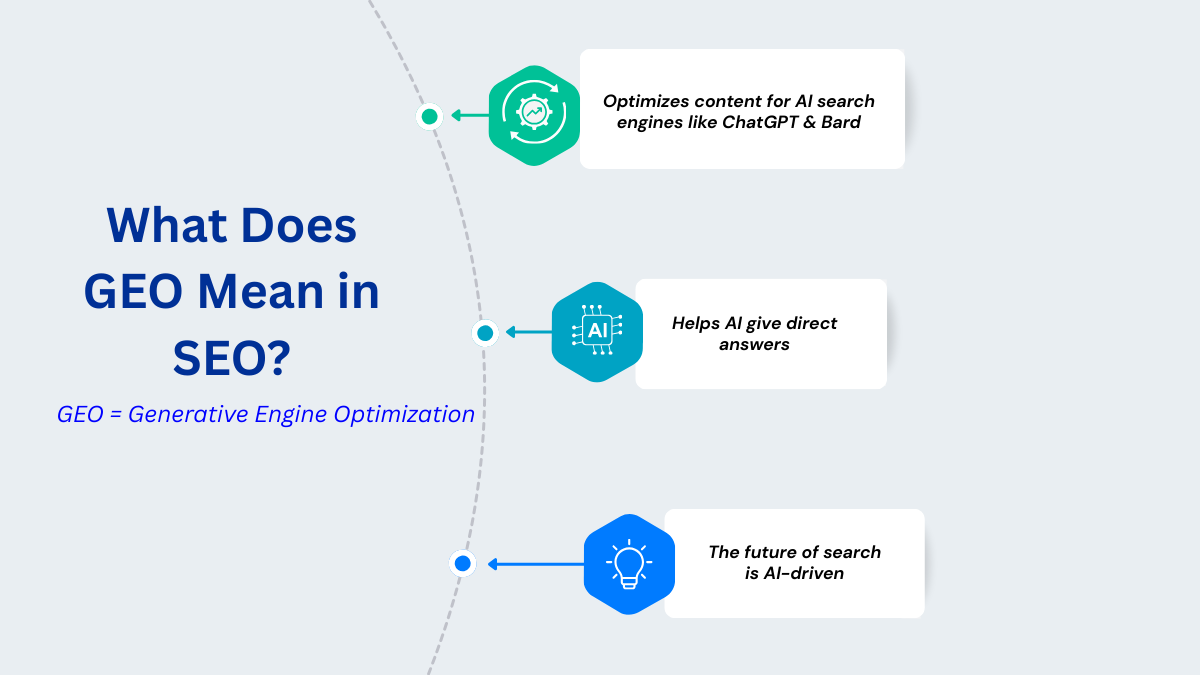
What Does GEO Mean in SEO?
Understanding Traditional SEO: The Foundation
To fully grasp SEO vs GEO, we need to start with a solid understanding of traditional Search Engine Optimization. SEO has been the backbone of digital marketing for over two decades, helping businesses improve their visibility on search engines like Google, Bing, and Yahoo.
Traditional SEO focuses on several key areas that work together to improve your website’s search rankings. Technical SEO services ensure that your website loads quickly, has clean code, and provides a smooth user experience. On-page optimization involves strategically placing keywords throughout your content, creating compelling meta descriptions, and structuring your pages properly. Off-page SEO builds authority through quality backlinks and social signals.
Local SEO has become particularly important for businesses serving specific geographic areas. A local SEO agency in India might help a Mumbai restaurant appear when someone searches for “best pasta near me” or assist a Bangalore software company in ranking for “web development services Bangalore.” This geographical targeting has proven highly effective for businesses with physical locations or service areas.
Mobile SEO has also gained tremendous importance as more people use smartphones for their searches. Google’s mobile-first indexing means that your website’s mobile version is what gets evaluated for rankings. This shift has made responsive design and fast mobile loading speeds critical factors for success.
The evolution of SEO has also seen the rise of specialized services. Ecommerce SEO services help online stores optimize product pages and category structures. White label SEO allows agencies to offer search optimization services under their own brand. International SEO agency services help businesses rank in multiple countries and languages. Each of these specializations requires deep expertise and ongoing attention to algorithm updates.
What is GEO and How Does It Work?
Now that we understand traditional SEO, let’s explore the other side of SEO vs GEO. Generative Engine Optimization represents a paradigm shift in how we think about search optimization. Instead of optimizing for search engine results pages, GEO focuses on making your content AI-friendly so that generative engines can easily extract and cite your information.
Generative engines work differently from traditional search engines. When you ask ChatGPT or Google’s Bard a question, these systems don’t just find relevant web pages. Instead, they analyze vast amounts of information, understand the context of your question, and generate a comprehensive response that synthesizes information from multiple sources.
This process has significant implications for content creators and marketers. Your content might not receive direct traffic from these AI tools, but it could be referenced and cited in responses to thousands of queries. This creates a new form of brand exposure and authority building that traditional SEO metrics don’t capture.
The concept of AEO in SEO (Answer Engine Optimization) is closely related to GEO. While GEO focuses on generative AI engines, AEO optimizes content for any system that provides direct answers to queries, including Google’s featured snippets and voice search results. Together, SEO, GEO, and AEO represent the three pillars of modern search optimization.
Understanding how generative engines select and cite sources is crucial for effective GEO. These systems typically favor content that is well-structured, factually accurate, and provides clear, comprehensive answers to common questions. They also value content that demonstrates expertise, authoritativeness, and trustworthiness – principles that align well with Google’s E-E-A-T guidelines.
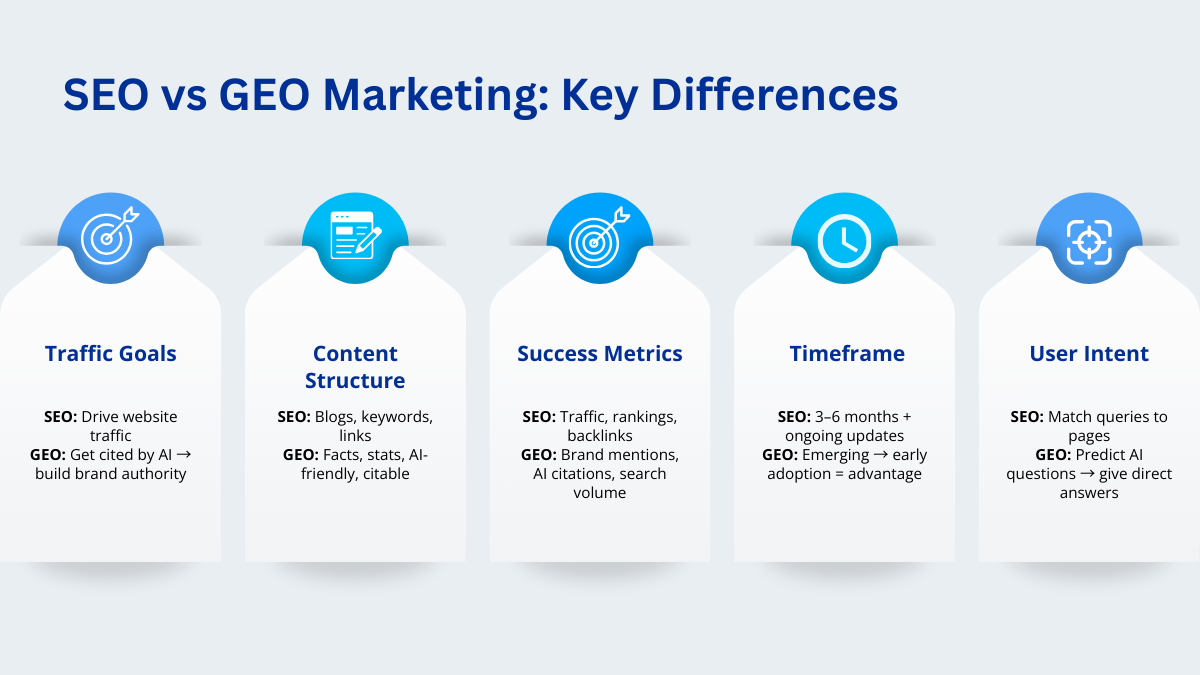
The Key Differences: SEO vs GEO Marketing
Is GEO the New SEO? Understanding the Evolution
One of the most debated questions in digital marketing today is whether GEO represents the future of search optimization. The answer isn’t straightforward, and understanding this evolution is crucial for making informed marketing decisions.
GEO isn’t necessarily replacing traditional SEO but rather complementing it. Search engines continue to drive billions of visits to websites every day, and traditional SEO remains vital for business success. However, the growing popularity of AI assistants and generative search tools means that GEO is becoming increasingly important.
The integration of AI features into traditional search engines blurs the line between SEO and GEO. Google’s Search Generative Experience, for example, provides AI-generated summaries alongside traditional search results. This hybrid approach means that marketers need to optimize for both traditional rankings and AI-powered features.
Different industries are seeing varying rates of GEO adoption. Industries focused on quick answers and information delivery, such as healthcare, finance, and education, are seeing faster adoption of generative search tools. E-commerce and local businesses may find that traditional SEO remains more important for driving traffic and conversions.
The evolution from SEO to GEO also reflects changing user behaviors. Younger users, in particular, are increasingly comfortable asking AI assistants complex questions instead of typing keywords into search engines. This behavioral shift suggests that GEO will become more important over time, even if it doesn’t completely replace traditional SEO.
Digital marketing services are beginning to adapt by offering both SEO and GEO optimization. Forward-thinking agencies are training their teams on AI optimization techniques while maintaining expertise in traditional search engine optimization. This dual approach ensures that clients are prepared for both current and future search landscapes.
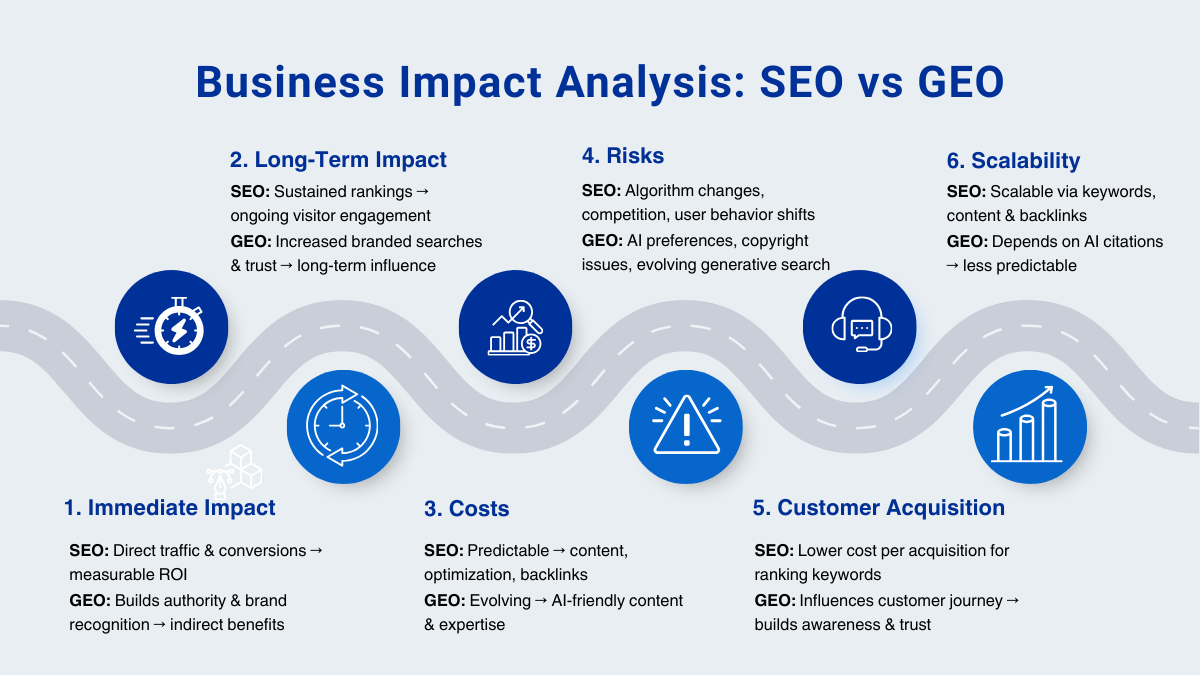
Business Impact Analysis: SEO vs GEO
Technical Implementation: Making the Right Choice
Implementing either SEO or GEO strategies requires different technical approaches and expertise. Understanding these requirements helps businesses make informed decisions about resource allocation and team development.
Traditional SEO implementation is well-established and supported by numerous tools and platforms. Technical SEO services can audit your website for speed, mobile-friendliness, and crawlability issues. SEO content writing follows proven formulas for keyword optimization, internal linking, and user engagement. Most digital marketing agencies have developed systematic approaches to SEO implementation that can be applied across different industries and business types.
GEO implementation is less standardized but follows some emerging best practices. Content needs to be structured with clear headers, factual information, and comprehensive coverage of topics. Schema markup becomes even more important for helping AI engines understand your content structure and context. The focus shifts from keyword density to information density and factual accuracy.
The choice between SEO vs GEO often depends on your business model and goals. E-commerce businesses might prioritize traditional SEO to drive traffic to product pages, while service-based businesses might benefit more from GEO to establish expertise and authority. Many successful strategies combine both approaches, optimizing for traditional search engines while ensuring content is AI-friendly.
Team skill requirements differ between these approaches. SEO specialists need expertise in keyword research, technical optimization, and link building. GEO specialists need to understand AI behavior, content structure for machine readability, and emerging trends in generative search. Some professionals are developing expertise in both areas to provide comprehensive optimization services.
Tools and measurement systems are more mature for SEO than for GEO. SEO packages typically include established tools for rank tracking, backlink analysis, and technical auditing. GEO measurement requires newer tools and approaches, including AI response monitoring and brand mention tracking across generative platforms.
Industry-Specific Applications
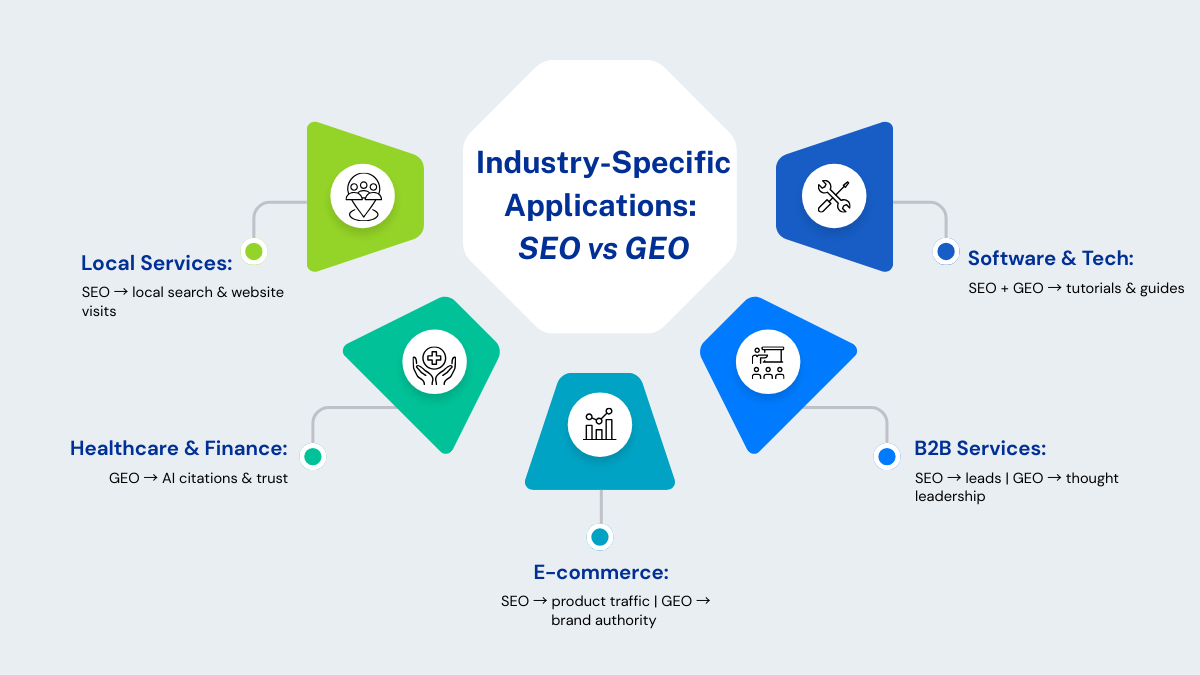
Local service businesses, such as restaurants, law firms, and medical practices, typically benefit most from traditional local SEO strategies. When someone searches for “dentist near me” or “best pizza delivery,” they want to find businesses in their area and visit their websites or call them directly. A local SEO agency in India would focus on Google My Business optimization, local citations, and location-based content for these businesses.
Content Strategy Adaptations
Creating content that works for both SEO vs GEO requires understanding how each approach processes and values information. Modern content strategies need to balance traditional SEO requirements with the emerging needs of AI-powered search systems.
Traditional SEO content writing focuses on engaging human readers while incorporating relevant keywords naturally throughout the text. Headlines are designed to encourage clicks, and content structure follows formats that have proven successful for user engagement and search rankings. SEO copywriting emphasizes persuasive language, emotional connections, and clear calls to action.
GEO content requires a different approach that prioritizes factual accuracy, comprehensive coverage, and a clear information hierarchy. AI engines prefer content that directly answers questions, provides specific data points, and maintains consistent formatting. This doesn’t mean the content should be robotic or boring, but it should be structured in ways that AI systems can easily parse and understand.
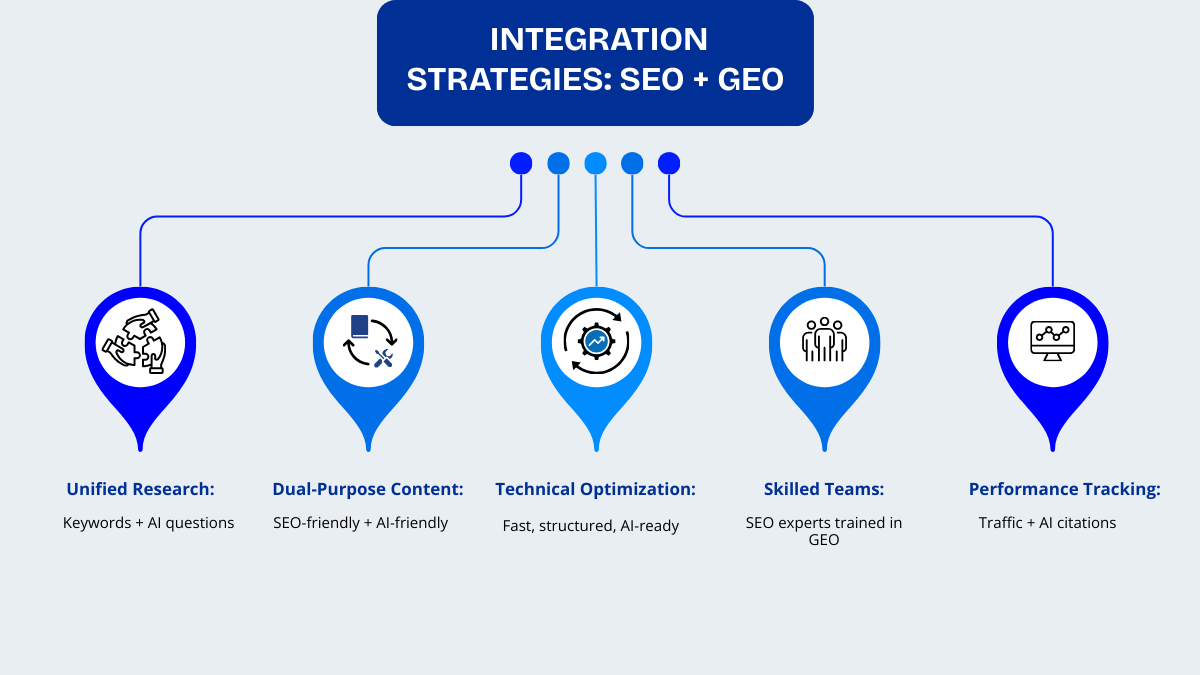
The integration of these approaches often produces the best results. Content that starts with thorough research, presents information clearly, and maintains engaging readability can satisfy both AI engines and human readers. This dual-purpose approach requires more planning but provides broader reach and effectiveness.
Content marketing agencies are adapting their strategies to address both SEO and GEO requirements. They’re creating content frameworks that include structured data, comprehensive topic coverage, and engaging presentation. This evolution reflects the changing landscape of search and the need for content that works across multiple platforms and systems.
Successful content strategies also consider the customer journey differently for SEO vs GEO. Traditional SEO content often targets users at different stages of the buying funnel, from awareness to decision-making. GEO content might reach users at the research phase, influencing their understanding and preferences before they ever visit your website or engage directly with your brand.
Measuring Success and ROI
Determining the return on investment for SEO vs GEO strategies requires different metrics and measurement approaches. Understanding these differences helps businesses allocate resources effectively and demonstrate value to stakeholders.
Traditional SEO measurement is well-established and includes metrics like organic traffic growth, keyword ranking improvements, and conversion rates from organic search. Tools like Google Analytics, Google Search Console, and various SEO platforms provide detailed insights into performance. Businesses can calculate clear ROI by comparing SEO investment to revenue generated from organic traffic.
Measuring GEO success requires more creative approaches because AI engines don’t typically drive direct traffic to websites. Marketers track brand mentions in AI responses, monitor citation frequency across different AI platforms, and measure indirect effects like increased branded search volume or improved brand sentiment. Some businesses use specialized tools to monitor when their content appears in AI-generated responses.
The time frame for measuring success differs between these approaches. SEO results typically become apparent within three to six months of consistent effort, with ongoing improvements visible through regular monitoring. GEO impact may take longer to materialize and might require different attribution models to understand the full business impact.
Attribution challenges are more complex with GEO because the path from AI citation to business outcome isn’t always direct. A potential customer might receive information about your brand from an AI assistant, research your company weeks later, and eventually make a purchase through a different channel entirely. This extended, multi-touch customer journey requires sophisticated tracking and attribution systems.
Budget allocation for SEO vs GEO should reflect both measurable outcomes and strategic objectives. Businesses with immediate revenue needs might prioritize traditional SEO for its direct traffic generation capabilities. Companies focused on long-term brand building and authority establishment might invest more heavily in GEO strategies, even if the immediate ROI is less clear.
Integration Strategies: Best of Both Worlds
Future Considerations and Trends
The landscape of SEO vs GEO continues evolving rapidly, and understanding emerging trends helps businesses prepare for future changes in search behavior and technology.
The integration of AI features into traditional search engines suggests that the distinction between SEO and GEO may become less clear over time. Google’s Search Generative Experience, Bing’s AI chat features, and other hybrid approaches indicate that future search optimization will need to address both traditional ranking factors and AI-powered features simultaneously.
Voice search continues growing in popularity, particularly among younger users and in specific contexts like driving or cooking. This trend favors content optimized for conversational queries and direct answers, which aligns more closely with GEO principles than traditional SEO approaches. Businesses that prepare for this shift by creating content that works well for voice queries may gain competitive advantages.
The development of specialized AI assistants for different industries and use cases creates new opportunities for targeted GEO strategies. Healthcare AI assistants, financial planning tools, and industry-specific chatbots each have unique requirements and preferences for content structure and presentation. Understanding these specialized systems may become important for businesses in relevant industries.
Privacy concerns and AI training data policies may affect how generative engines access and cite web content. Changes in these policies could impact the effectiveness of GEO strategies and require adaptations in how businesses structure and present their content. Staying informed about these policy changes will be crucial for long-term success.
The emergence of new AI platforms and search tools creates ongoing opportunities for early adopters. Businesses that quickly understand and optimize for new generative search systems may gain first-mover advantages, similar to how early SEO adopters benefited when Google became dominant. Monitoring the development of new AI-powered search tools should be part of comprehensive digital marketing strategies.
Frequently Asked Questions
1. What does GEO mean in SEO?
GEO stands for Generative Engine Optimization, which focuses on optimizing content for AI-powered search engines and chatbots that generate direct answers to user queries. Unlike traditional SEO that optimizes for search engine results pages, GEO optimizes content so that AI engines can easily understand, extract, and cite your information when creating responses for users.
2. What is the difference between GEO and traditional SEO?
The main difference lies in their optimization targets and goals. Traditional SEO optimizes websites to rank higher in search engine results pages and drive traffic directly to your site. GEO optimizes content to be easily understood and cited by AI engines, which may not drive direct traffic but builds authority and brand recognition through citations in AI-generated responses.
3. Is GEO the new SEO?
GEO isn’t replacing traditional SEO but rather complementing it. Both approaches serve different purposes in the modern search landscape. Traditional SEO continues to drive significant website traffic and conversions, while GEO helps build authority and brand awareness through AI citations. Most successful strategies combine both approaches rather than choosing one over the other.
4. What is the difference between SEO and GEO business impact?
SEO provides direct, measurable business impact through website traffic, leads, and conversions that can be easily tracked and attributed. GEO offers more subtle, long-term impact through brand authority building, increased awareness, and trust development. While SEO shows immediate ROI through traffic and sales, GEO builds long-term brand value that may influence customer decisions across multiple touchpoints.
5. How do SEO, GEO, and AEO work together?
SEO, GEO, and AEO (Answer Engine Optimization) represent three complementary approaches to search optimization. SEO focuses on traditional search engine rankings, GEO targets AI-generated responses, and AEO optimizes for any system that provides direct answers, including featured snippets and voice search. Together, they create a comprehensive optimization strategy that covers all major ways users search for and consume information online.
1. What does GEO mean in SEO?
GEO stands for Generative Engine Optimization, which focuses on optimizing content for AI-powered search engines and chatbots that generate direct answers to user queries. Unlike traditional SEO that optimizes for search engine results pages, GEO optimizes content so that AI engines can easily understand, extract, and cite your information when creating responses for users.
2. What is the difference between GEO and traditional SEO?
The main difference lies in their optimization targets and goals. Traditional SEO optimizes websites to rank higher in search engine results pages and drive traffic directly to your site. GEO optimizes content to be easily understood and cited by AI engines, which may not drive direct traffic but builds authority and brand recognition through citations in AI-generated responses.
3. Is GEO the new SEO?
GEO isn’t replacing traditional SEO but rather complementing it. Both approaches serve different purposes in the modern search landscape. Traditional SEO continues to drive significant website traffic and conversions, while GEO helps build authority and brand awareness through AI citations. Most successful strategies combine both approaches rather than choosing one over the other.
4. What is the difference between SEO and GEO business impact?
SEO provides direct, measurable business impact through website traffic, leads, and conversions that can be easily tracked and attributed. GEO offers more subtle, long-term impact through brand authority building, increased awareness, and trust development. While SEO shows immediate ROI through traffic and sales, GEO builds long-term brand value that may influence customer decisions across multiple touchpoints.
5. How do SEO, GEO, and AEO work together?
SEO, GEO, and AEO (Answer Engine Optimization) represent three complementary approaches to search optimization. SEO focuses on traditional search engine rankings, GEO targets AI-generated responses, and AEO optimizes for any system that provides direct answers, including featured snippets and voice search. Together, they create a comprehensive optimization strategy that covers all major ways users search for and consume information online.




Get in Touch!
Error: Contact form not found.
Related Posts
Stay updated and join the buzz with these topics